
from Yahoo News - Latest News & Headlines https://ift.tt/3dBd8qi
from Yahoo News - Latest News & Headlines https://ift.tt/3dBd8qi

from Yahoo News - Latest News & Headlines https://ift.tt/2w3wzat

from Yahoo News - Latest News & Headlines https://ift.tt/2QXu7JT

from Yahoo News - Latest News & Headlines https://ift.tt/2UOsiQx

from Yahoo News - Latest News & Headlines https://ift.tt/2xGzp5r

from Yahoo News - Latest News & Headlines https://ift.tt/2QYoP0w

from Yahoo News - Latest News & Headlines https://ift.tt/2ynpUbW

from Yahoo News - Latest News & Headlines https://ift.tt/2xCXA53
Every weekday evening, our editors guide you through the biggest stories of the day, help you discover new ideas, and surprise you with moments of delight. Subscribe to get this delivered to your inbox.
One of the many dreadful side effects of our collective distancing is quiet, a miserable, seismologically registrable quiet. The white noise of everyday life—the humming of your local bar, the turning of car tires—is lost. In its place is the unpleasant silence of a whole world stuck on pause.
Let’s fix that. Today, we offer a playlist, assembled by three of our music critics: Hannah Giorgis, Spencer Kornhaber, and James Parker. They each picked a few tracks, each tuned to one of the very specific moods you might be experiencing during this period of self-quarantine.
A kitschier newsletter might ask you to now turn up your bass and fill the aforementioned void with sound waves from your speaker. But we’ll just leave this Spotify link here and let you decide what to do next.
For perking up without wanting to go anywhere:
“Party” by Planet 1999
Pop music’s caffeine tastes sour lately—it’s too brash, too silly, and too in love with the physical world—so instead I’ve regulated my energy with gentle, abstracted substitutes. In the video for this happy-slurry dance track, folks in casual wear bop around a digital purgatory, which feels awfully relatable. — SK
For when all you can do is stare out the window like the lead of an indie movie:
“Cut Me” by Moses Sumney
As the days stretch on, so does the space for constant rumination. Thankfully, “Cut Me,” the fourth single from Moses Sumney’s græ: Part 1, washes over you with all the force and reassurance of a hot shower. Cry if you need to; nothing is more human. — HG
For a boost to the immune system:
“Misfit Love” by Queens of the Stone Age, live in the studio at The Henry Rollins Show, 2007
Look at this band, these dudes: the greasy, druggy, stylish, heavy, humid closeness and consanguinity of it all. Look at them building this sick, sick groove in successive loops of wonder, in layers of inevitability, in a kind of scowling ecstasy, as if they’re inventing not just music but the idea of music. Inhale this; get it deep inside your body. This is medicine. — JP
For post-videochat melancholy:
“Where Are You Judy?” by Andy Shauf
The fantastic new album by sleepy-voiced strummer Andy Shauf is about spending a night out at the bars yet remaining stuck inside one’s own head. Here he fantasizes about an ex calling him up to reconnect, and it’s a weirdly comforting reminder that pre-quarantine freedom had its quiet madness too. — SK
For when you can’t concentrate:
“Sex” by the Necks
In this general glut of horrible news, horrible numbers, and pestilential vibes, it can be—let’s put it mildly—hard to focus. The Necks are an Australian improvisational trio, and “Sex” is a nearly hour-long voyage into the galaxy that Miles Davis discovered with In a Silent Way. Slow, twinkling, irreversible build; beckoning theta-states. Whatever you’re doing when you put this on, you’ll start to do it better. — JP
For when only Morrissey will do:
“My Hurling Days Are Done” by Morrissey
Forgive him his trespasses, as he might—actually probably wouldn’t—forgive yours. A yodeler on the Alp of himself, calling in his lost sheep, his black sheep, his whipping boys, in that rich and curling tenor, this, ah, complex individual is still in magnificent voice, and still capable of writing superbly, as demonstrated by this cut from his new album, I Am Not a Dog On a Chain. — JP
For a dramatic lip-sync session in the mirror:
“It’s All Coming Back to Me Now” by Céline Dion
Sure, this is one of the strangest songs ever written, but just think of it as an ode to the outside world, which you’ll see again … someday. — HG
For an important reminder not to text your ex:
“Si Veo a Tu Mamá” by Bad Bunny
Listen, I get it—social distancing has made dating really weird! But that’s no excuse to go full “Marvins Room.” Instead of Drake, let Bad Bunny be your muse: “Si Veo a Tu Mamá” is a rueful message to a lost lover who’s already moved on, but it’s also a bouncy introduction to the Puerto Rican phenom’s incredibly fun new album, YHLQMDLG. Rather than yearning ad nauseam, Bad Bunny looks forward. Do the same, and dance along. — HG
For your eerie but life-affirming walk around the neighborhood:
“Happy Cycling” by Boards of Canada
How did the ambient musicians of Boards of Canada anticipate this experience 22 years ago? The stores are closed, the gulls are jeering, and yet you pace ahead to thwart leg cramps. Five minutes in, the endorphins assemble, the creepiness lessens, and there’s an unidentifiable new feeling that might even be related to hope. — SK
For your personal happy hour:
“Stay Flo” by Solange
Solange’s collage-like 2019 album When I Get Home has never made more sense. It’s like she’s trying to remember the chaos of the outside world, rhythm first, and ends up conjuring some fresh, bizarre, and ultimately pleasing sense of order. — SK
For breaks from the news:
“What’s Going On” by Marvin Gaye
Because obviously. Gaye voiced Vietnam-era outrage, but never has a sigh of “WTF” sounded so consoling or pure. — SK
For when you’d rather be on a different planet:
“Celebration Station” by Lil Uzi Vert
Lil Uzi Vert isn’t subject to the same rules as the rest of us. Where we might trudge through life, the 25-year-old Philadelphia rapper glides. That’s never been more obvious than on the long-awaited Eternal Atake, his recent chart-topping second studio album. Uzi immediately followed it up with a separate 11-track record, Eternal Atake (Deluxe) – LUV vs. The World 2. It’s nearly impossible to pick just one song from the extraterrestrial experience that is the double release, but “Celebration Station” is a roller coaster unto itself. The run from 1:49 to 2:11 will roll through you with so much energy, it’ll feel almost like wind blowing through your hair again. — HG
For thinking about when it’s all over:
“One Love Jam Down” by Papa Michigan & General Smiley
“The social barriers come down / Together in a one-love jam down.” We’re told that there likely won’t be a V-E Day on this thing, no single joyful scream-of-the-whistle moment where we all rush into one another’s arms and orgiastically reverse the months-long damage of social distancing. But we can dream—and the combined bass-synth squelch on this 1980 classic of positive reggae can keep our dreams juicy. — JP
Listen to this on Spotify. What song do you find yourself returning to in this tense moment? Send us your own pick (along with the corresponding quarantine mood), and we may highlight it in a future edition of the newsletter.
What to read if … you just want practical advice:
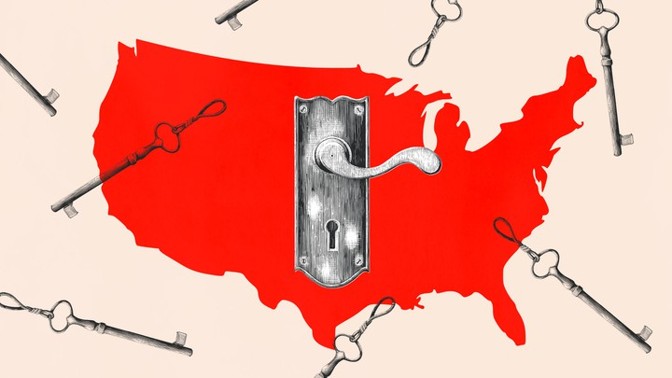
One question, answered: Why doesn’t the U.S. have a national lockdown?
Other countries—including Western democracies such as Italy, Spain, and France—have responded to the coronavirus crisis by shutting down entire regions or the nation as a whole. America, which currently has the most known COVID-19 cases of any country, has not.
Two health-law experts explain how America’s federalist system limits its response options:
Constitutional authority for ordering major public-health interventions, such as mass quarantines and physical distancing, lies primarily with U.S. states and localities via their “police powers.”
Today’s Atlantic-approved self-quarantine activity:
Try last year’s six-part British drama Years and Years, an eerily timely—and oddly comforting—series about family life against a backdrop of constant crisis. In the show, “simply carrying on is portrayed as the key to survival,” our critic writes.
What to read if … you’d like to read about something—anything—other than the coronavirus:
The wellness movement is booming—and so are opportunities to profit from it.
We are continuing our coverage of the coronavirus. View all of our stories related to the outbreak here. Let us know if you have specific questions about the virus—or if you have a personal experience you’d like to share with us. In particular, we’d like to hear about how the pandemic has affected your family life—whether that’s child care, partner relationships, or any other family dynamic.
This email was written by Caroline Mimbs Nyce, with help from Isabel Fattal. Sign yourself up for The Daily here

It’s Tuesday, March 31. Backlogs at private laboratories have ballooned, making it difficult to treat suffering patients and contain the pandemic. Read the latest from our science and technology reporters Alexis Madrigal and Robinson Meyer.
In the rest of today’s newsletter: When the coronavirus pandemic comes to Trump country, politicization can only last so long. Plus: What’s the deal with Oscar Health and COVID-19 testing?
*
« TODAY IN POLITICS »
(Patrick Semansk / AP)
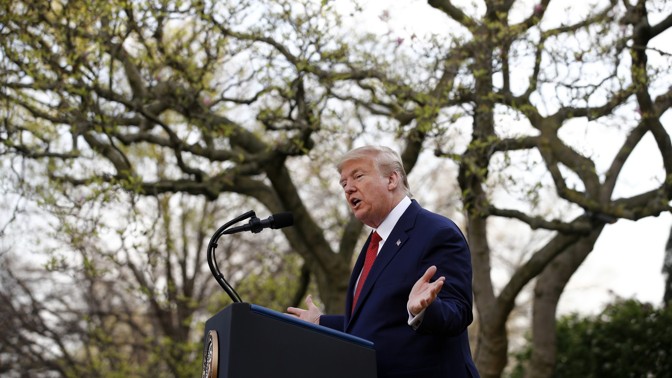
Thus far, the coronavirus outbreak has ravaged blue states and Democratically-leaning cities more than red states and rural areas (though the illness is spreading quickly). President Trump has spoken about the pandemic through a highly partisan lens, and has expressed belief that state and local governments haven’t been happy enough with the administration’s help, my colleague Peter Nicholas, our White House correspondent, writes:
Trump, though, is sensitive to anything he sees as ingratitude. If his administration sends planeloads of ventilators—a national resource—he wants a thank you, not a complaint about why it didn’t come sooner.
But as the virus spills widely across more red states, more Republican governors must figure out how to navigate the White House’s shifting moods.
But as the virus spills into more red states, Republican governors must figure out how to navigate his shifting moods. (That hasn’t stopped the president from taking credit for any positive development and parroting false news of progress to his base.)
The federal government can only do so much to enforce national restrictions, even if an aggressive one would help slow the pandemic’s spread. If the president wanted to enact a nationwide lockdown, akin to those in China, India and the UK, the way the federal government is designed prevents him from being able to do so.
On the economic front, drastic times call for drastic measures. Rather than shipping out one-time $1,200 checks to save the economy, here’s one idea for the Federal Reserve to stave America off long-term economic disaster, Annie Lowrey writes: Throw money out of helicopters. Really.
—Kaila Philo
*
« THE CORONAVIRUS READER »

(Getty Images / The Atlantic)
+ The president has promised a website devoted to coronavirus testing. He said Google would help; instead, it was built by Oscar Health, an insurance company closely tied to son-in-law Jared Kushner.
+ There’s some amount of political genius in the support the president has managed to maintain amid national calamity, Frida Ghitis argues: He’s somehow “transmuting his calamitous failures into political gold.” Here’s how.
+ Prisons are vulnerable environments for a pandemic. The new coronavirus will be a nightmare for those who might’ve been wrongly convicted.
You can keep up with The Atlantic’s most crucial coronavirus coverage here.
*
Today’s newsletter was written by Kaila Philo, a Politics fellow. It was edited by Shan Wang, who oversees newsletters.
You can reply directly to this newsletter with questions or comments, or send a note to politicsdaily@theatlantic.com.
Your support makes our journalism possible. Subscribe here.


Aged 19 and incarcerated on Rikers Island, Bianey Garcia and a friend — victims of a homophobic attack that had led to their arrests, Garcia says — needed help. They called Lorena Borjas.
A pillar of New York City’s Latinx LGBTQ community, Borjas had long been known as a staunch defender of the rights of trans people, Latinx people, undocumented people and sex workers. Borjas helped Garcia and her friend obtain a lawyer, who won their case and later helped them get immigration papers to stay in the U.S. A decade later, Garcia is now a justice workwr with New York City-based advocacy organization Make the Road. “Lorena was like a mother for many in the transgender community,” Garcia tells TIME. “She used to help anyone.“
On Monday, March 30, Borjas died from complications related to coronavirus, officials announced, a loss that has rocked the trans community of Queens, N.Y., and beyond. She was 60, per NBC New York.
“Lorena Borjas was a real hero for trans people, especially in Queens. She was a leader, a builder and a healer,” Mara Keisling, the executive director of the National Center for Transgender Equality, said in a statement. “The NCTE family is saddened by her passing and has her broad family and the Queens Latinx community in our hearts today.”
Borjas had been a prominent community organizer and health educator for decades, working to end human trafficking, which she herself survived, according to the Transgender Law Center. In 2017, she received a rare pardon from New York Governor Andrew Cuomo for a conviction she received in the 1990s while being trafficked, with Gov. Cuomo praising her advocacy work in New York state. (The conviction had put Borjas, a Mexican national, at high risk of deportation.)
Her community health work included a HIV testing site Borjas set up in her own home, and a syringe exchange program for trans-women using hormone injections, according to Gov. Andrew Cuomo’s office. In 2012, she and activist Chase Strangio co-founded the Lorena Borjas Community Fund, which helped cover bail and pay legal fees for for LGBTQ immigrants.
Just a few weeks ago, Borjas set up a fund for trans-people who had lost their jobs to COVID-19, the disease caused by novel coronavirus.
Activists and community leaders across New York City took to social media after the news of her death broke.
“Lorena was honestly one of the most amazing women I’ve ever met,” Lynly Egyes, the legal director of the Transgender Law Center, tells TIME. “She was an activist, a warrior, a mother to so many.”
Egyes, 38, says she first met Borjas while working for the Sex Workers Project at the Urban Justice Center. At the time, Egyes remembers she was representing two incarcerated transgender women; Borjas “just showed up” with a much-needed birth certificate for one of the women, pulling it out of the Mary Poppins roller bag she always carried with her. “You never knew what was in there,” Egyes laughed.
Egyes later represented Borjas while campaigning for her pardon, and says she she received scores of letters during that time from people who said “Lorena literally saved my life.” They told Egyes about times Borjas protected them from an abusive partner or took them into her home when they had nowhere else to go. “That wasn’t an uncommon story about Lorena,” Egyes says. “[She would] provide services and resources to anyone who just got to New York City and needed a hand or help,” she continues. “And she did this without pay. She just did it because it was the right thing to do.”
“What I lived through helped me fight for justice for my sisters,” Borjas said in a 2018 interview. “My goal in life is to help them in everything I can.”
Cristina Herrera, the CEO and founder of the non-profit Translatinx Network, describes Borjas as an outgoing and resourceful woman who was “determined to make her visions come true.” Over the 32 years the women knew each other, Herrera, 49, tells TIME she watched Borjas grow into a respected and powerful community leader. “She was a source of strength for many of us,” Herrera adds.
“She’s made the world better so selflessly, so humbly, without often any type of recognition,” Egyes says. “I think she taught everyone she knew about how to be a better person.”


CONCORD, New Hampshire — Tomie dePaola, the prolific children’s author and illustrator who delighted generations with tales of Strega Nona, the kindly and helpful old witch in Italy, died Monday at age 85.
DePaola died at the Dartmouth-Hancock Medical Center in Lebanon, New Hampshire, according to his literary agent, Doug Whiteman. He was badly injured in a fall last week and died of complications following surgery.
He worked on close to 250 books in a half century of publishing. More than 15 million copies have been sold worldwide and his books have been translated into more than 20 languages.
Strega Nona, his most endearing character, originated as a doodle at a dull faculty meeting at Colby Sawyer College in New London, New Hampshire, where dePaola was a member of the theater department. The first tale was based on one of his favorite stories as a child, about a pot that keeps producing porridge. “Strega Nona: An Original Tale,” which came out in 1975, was a Caldecott finalist for best illustrated work. Other books in the series include “Strega Nona’s Magic Lessons” and “Strega Nona Meets Her Match.”
Reflecting on her popularity, dePaola told The Associated Press in 2013, “I think it’s because she’s like everybody’s grandmother. She’s cute, she’s not pretty, she’s kind of funny-looking, but she’s sweet, she’s understanding. And she’s a little saucy, she gets a little irritated every once in a while.”
DePaola said he put Strega Nona in Calabria, in southern Italy, because that’s where his grandparents came from.
He said over the years, the visualization of Strega Nona — who grew out of his drawing of Punch from the commedia dell’arte — became more refined. But his liberal use of color and folk art influences in her stories were a constant. After saving her village from being flooded with pasta from a magic pot by her assistant, Big Anthony, Strega Nona went on to star or play a supporting role in about a dozen more books.
“I remember laughing at the pictures of Big Anthony, the townspeople, and even cute little Strega Nona,” wrote one of his many fans in 2013, a woman who recalled her mother reading the book to her growing up. “She is ingrained in my childhood … I hope to read Strega Nona to my kids one day.”
In 2011, dePaola received a lifetime achievement award from the American Library Association.
“Tomie dePaola is masterful at creating seemingly simple stories that have surprising depth and reflect tremendous emotional honesty,” the committee chair Megan Schliesman said at the time. “They have resonated with children for over 40 years.”
At age 4, dePaola knew he was going to be an artist and author — and he told people so. He received a lot of encouragement from his family. “They gave me half of the attic for my ‘studio.’ Now, how neat is that?” he said.
His family, in turn, became central characters in a number of his autobiographical books, such as “26 Fairmont Avenue,” about growing up in Connecticut during the Great Depression, and “The Art Lesson,” about reaching a compromise with his art teacher on drawing in class. The former received a Newbery Honor Award in 2000.
DePaola wrote about doodling on his bedsheets and on his math work in second grade, telling his teacher he wasn’t going to be an “arithmetic-er.”
Many of his books bring to life folktales, legends, and spirituality — he often incorporated images of a white dove among the pages. Christmas, his favorite holiday, was a popular subject of many of his works exploring traditions of the season, and offered some storylines for Strega Nona.
In 2013-2014, dePaola had two exhibitions at Colby-Sawyer College, “Then,” and “Now.” The first showed his early artistic efforts, his formative years at the Pratt Institute and his work, influenced by Fra Angelico and George Roualt, among others; the second came out shortly after dePaola turned 80 and it focused on his more recent artwork.
“Even though I love doing my books and I try to be as creative as possible, there’s always a restriction,” he said in 2013. “I have to please other people, I have to please my art director, my editor, and then there’s all the public to please. Some of the books I’ve considered my best artistic personal accomplishments aren’t necessarily the books that appeal to children. And that’s OK.”
In 2011, dePaola received a lifetime achievement award from the American Library Association.
“Tomie dePaola is masterful at creating seemingly simple stories that have surprising depth and reflect tremendous emotional honesty,” the committee chair Megan Schliesman said at the time. “They have resonated with children for over 40 years.”
DePaola spent much of time working in his 200-year-old barn in New London, which houses his studio and library. It includes wall niches displaying folk art and a corner with a chair facing a small altar, where he meditated. More Native American, Mexican and early American folk art decorated his nearby home.
DePaola received many letters through the years from children with questions about his life and books, and he often took the time to chat with them at book signings and other events. It was always important to him to keep that voice active.
“I just keep the inner critic,” he said in an interview. “Don’t let the little 4-year-old get jaded. I listen to him. He stands beside me and says, ‘No, I don’t like that.’”


from Yahoo News - Latest News & Headlines https://ift.tt/3auZ7bG

from Yahoo News - Latest News & Headlines https://ift.tt/39pUFK3

from Yahoo News - Latest News & Headlines https://ift.tt/39vIAmR


from Yahoo News - Latest News & Headlines https://ift.tt/3bDG2EF

from Yahoo News - Latest News & Headlines https://ift.tt/3asAZGO

from Yahoo News - Latest News & Headlines https://ift.tt/2UpYgn2


